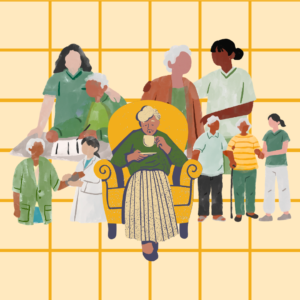
Health Partners on IPV +Exploitation and NCECE bring you a webinar and new educational brief, Intimate Partner Violence (IPV) and Elder Abuse in Later Life. The webinar will explore the prevalence and health impact of IPV in later life and elder abuse with guest speaker, Seema Kak, Executive Director of Kiran, Inc on Wednesday, March 11, 2026 at 8:00 AM HST/10:00 AM PST/11:00 AM MST/12:00 PM CST/1:00 PM EST for 60 minutes. Register here. This webinar will be presented in English with Spanish and ASL interpretation.
Perspectives from a Social Work Graduate Student
Working with older adults requires a unique blend of creativity, reflexivity, and cultural humility. Some social contexts emphasize respect for elders and to limit any push back to respect their authority. However, this is where the phrase “unconditional positive regard and conditional agreement” becomes especially useful. When applied thoughtfully, this framework encourages providers, caregivers, and advocates to lead with compassion while holding space for accountability, safety, and self-determination — especially when conversations shift into sensitive territory involving suspected or visible signs of elder abuse and intimate partner violence (IPV).
Prior to beginning my Master of Social Welfare (MSW) program at UC Berkeley in 2024, I worked as a housing case manager at a housing nonprofit organization in San Francisco. One experience that informed the concept mentioned above was my work with an 80‑year‑old participant who was experiencing financial exploitation by her formerly estranged son. During months when she did not directly give him a portion of her income, he would access her Social Security benefits card under the guise of “getting groceries” and withdraw funds for his own use. When I learned she was at risk of falling behind on rent, I raised the concern with her. She responded, “I know what I’m doing, but what am I supposed to do? He’s my son.”
For her, providing financial support was a mother’s duty and an expression of love. Overlooking her son’s actions was her way to protect the fragile relationship they had just rebuilt. That emotional truth outweighed her financial worries, even as it placed her housing at risk. Using unconditional positive regard, I acknowledged her choice as a mother in supporting her son. However, I utilized conditional agreement by encouraging her to consider other ways she can fulfill this commitment without compromising her immediate needs. Together, we explored possibilities such as setting allowance limits or enrolling him as an In-Home Support Service (IHSS) provider. Ultimately, she decided to enroll in a payee program through a local organization referred to us by Adult Protective Services (APS). This option ensured her rent, food, medication, and a small emergency fund were accounted for, while giving her the autonomy to use her remaining funds at her discretion.
This story is not unusual. Older adults navigating abuse or IPV are often balancing their desire for love against fears, obligations, and survival, all at the same time. Our role is to hold space for all of those existing thoughts without losing sight of their safety. The following strategies offer a starting point for intentionally doing that.
Reach Out & Be Reachable
Elder abuse and IPV are not caused by aging alone, but can be shaped by a combination of risk factors, including chronic illnesses, cultural norms, and societal expectations. Utilizing clinical visits, like routine check-ups or coordination calls, can be valuable opportunities to connect with older adults in ways that feel supportive and grounded in curiosity. Rather than relying solely on assessments, take a moment to build rapport with older adults who may feel hesitant to share concerns due to fear, past experiences, or unfamiliarity with a provider. By modeling care through consistent compassion and transparency, we support participants in recognizing the resources already available to them and create the conditions for them to reach out when they feel ready.
Collaborate
Some older adults who experience abuse or IPV don’t want the relationship to end — they want the abuse to stop. Supporting participants in determining how they want to move forward by listening nonjudgmentally and asking for permission to offer resources can help people feel less alone. This might look like jointly identifying one small safety step, revisiting a plan over multiple appointments, or simply asking “What would feel most helpful right now?” A solution that the client identifies themselves is one they are far more likely to use.
Offer Resources
Participants are often more open to receiving support when resources are offered as options and our care remains unchanged regardless of disclosure. The Aging With Respect safety card tool may be shared with participants as part of FUTURES’ evidence-based CUES intervention for addressing IPV within healthcare settings. Created in partnership with the National Clearinghouse on Abuse in Later Life, the safety card tool helps health care providers and staff open conversations with their patients about relationship concerns, discuss the health impacts of abuse, and makes connections to national hotlines. CUES is an acronym that stands for: Confidentiality, Universal Education, and Support, learn more here. Additional referrals that providers can offer patients include to the Warmline (a confidential, peer-run phone line that provides emotional support), APS, and to local community programs.
Whether you are an advocate, provider, or caregiver, the framework of “unconditional positive regard and conditional agreement” can create opportunities for deeper engagement with older adult participants. By acknowledging our client’s self-determination, we can support them in re-establishing safety for themselves and others, even in the most difficult conversations.
Author:
Katie Truong, CHW
Futures Without Violence, Social Worker Intern
Master of Social Welfare Candidate at UC Berkeley
Class of Spring 2026